
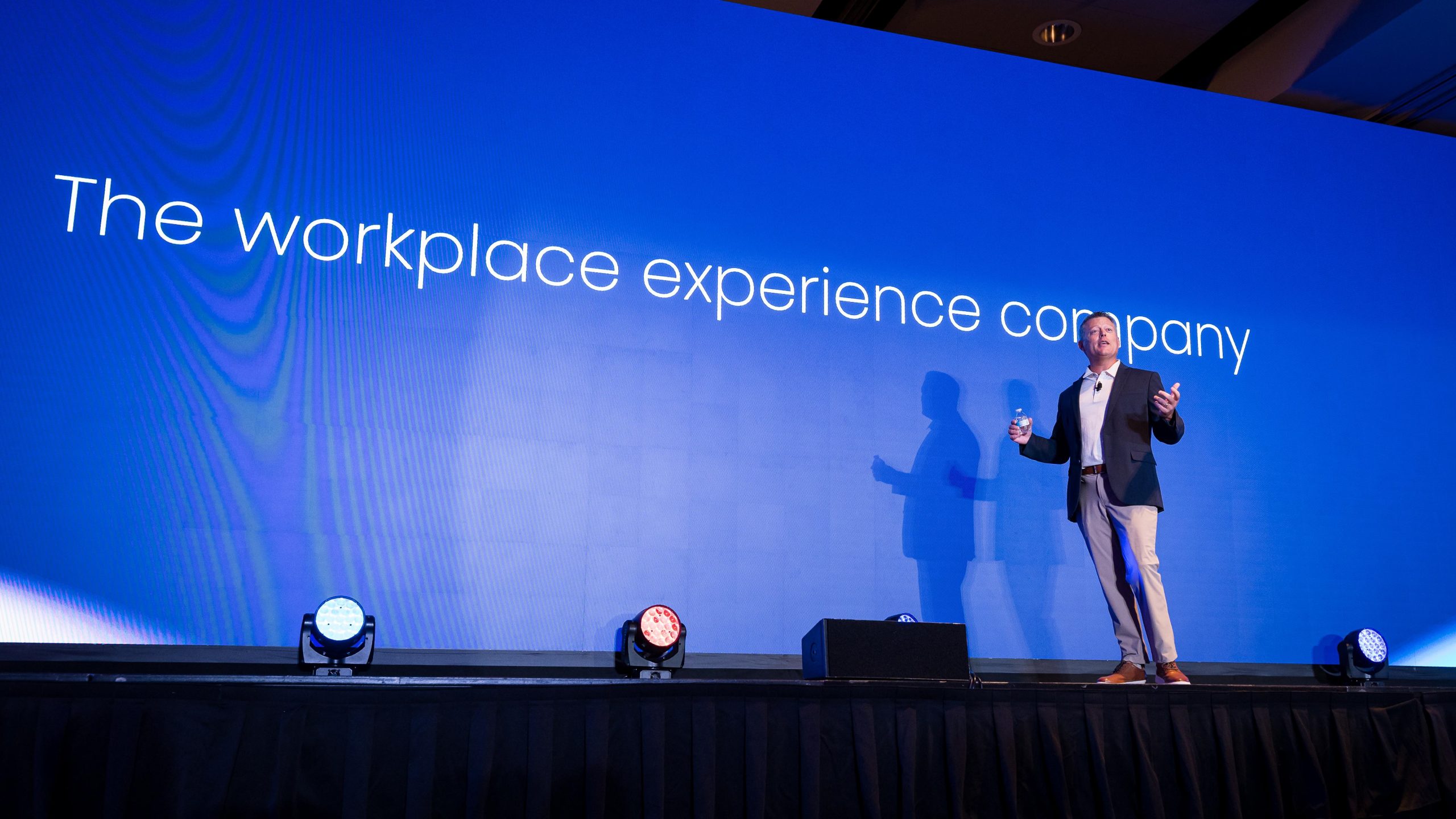
What it means to be the workplace experience company
Think about how you got through your weekend. You asked your phone a question and got an answer. Your bank flagged a payment before you’d noticed it. Your map rerouted you around traffic you never saw. You didn’t navigate anything. Things came to you. Work can feel that easy too, and as the workplace experience company, that’s exactly what we help you deliver.
Now think about Monday morning. Which app has the update about the office move? Do you know if anyone from your team is coming in on Wednesday? Was that policy change in the email, the intranet, the Teams channel, or the poster by the lifts?
That gap, between how easy life feels and how hard work can feel, is the story of the modern workplace. Employee expectations changed, shaped by consumer tech that just works. The technology powering work changed, multiplying into dozens of tools. And AI has hit the accelerator on all of it. Today, people don’t want to work out where to find an answer, they want the answer to find them, in context. This is the driver behind Appspace Context, which brings together signals from across the workplace to respond to the person, the place and the situation.
At Appspace, we call ourselves the workplace experience company. That’s a big claim, and we make it on purpose. Here’s what it means, why it matters to every organization, and what you can do right now to keep pace.
Work has an experience problem
Workplace experience is a simple idea. It’s the information people receive, the spaces they use and the tools they rely on, experienced as one thing by the person doing the work. We’re not talking about IT’s version, then HR’s version, and facilities’ version, but one experience.
For most people, that one experience doesn’t exist yet. Every year we ask employees across the US and UK how work is really going, and our 2026 workplace experience trends report didn’t pull its punches:
- 72% regularly feel out of the loop on important workplace information
- 81% say communication isn’t consistent across the places they’re expected to work
- More than half say their physical and digital workplaces still don’t feel connected
None of that is about effort or goodwill. It’s structural. Organizations solved workplace problems one tool at a time: a booking app here, a comms platform there, a screen in reception, an intranet nobody can find. Each tool fixed something. Together they created a new problem. People now spend way too much time navigating work instead of doing it.
That costs real money. New research from The Collab Collective shows a 1,000-person organization can lose up to $9 million a year to time spent coordinating work rather than doing it. And that’s before you count the frontline nurse who missed a shift update, or the hybrid worker who commuted in to an empty floor.
Here’s the bit we find most telling. When we asked people what would make work better, they didn’t ask for another app. They asked for one connected experience, communication that works across every channel, and better coordination between people, places and work.
Who owns workplace experience?
Try this. Who in your organization owns internal communications? Easy. Who owns your buildings and spaces? Easy. Who owns the tools everyone uses every day? Also easy.
Now: who owns the whole workplace experience?
For most organizations, the honest answer is nobody. Comms owns the message. Facilities owns the floor plan. IT owns the stack. HR owns the employee journey. Each team does good work in its lane. But employees don’t live in lanes. And that’s exactly where the experience breaks.
Workplace experience is everybody’s problem and nobody’s job. That’s the gap in the org chart, and it’s why so many well-funded initiatives deliver less than they promise.
We saw this coming. More than three years ago, we said workplace experience would become one of the biggest challenges organizations face, and that choosing whether to tackle it would shape their success. Some people thought we were early. We were. This year, Gartner published its first-ever Magic Quadrant™ for Workplace Experience, giving the category a name. Appspace was named a Leader, with the highest ability to execute and the highest completeness of vision.
So we decided the gap was ours to own. Not because we wanted a bigger slice of the software market, but because somebody had to make the workplace work for the people in it.
AI raised the bar (and exposed the foundations)
You can’t get through a meeting without someone mentioning AI. But the real shift sits underneath the hype. It’s the expectation AI has created. People don’t want to filter, click and dig for an answer anymore. They want the outcome, instantly, in context. That’s how life works now, and the train has left the station.
So the question for every organization is simple: does your workplace experience match that expectation?
Meeting it looks like this:
- Information finds you, rather than you hunting for it
- Your space knows what you need before you ask
- One message, written once, reaches everyone, automatically formatted for wherever it lands: a phone, a laptop, a screen in the break room
Here’s the industry’s blind spot. Agentic AI is moving faster than almost anything we’ve seen, and most organizations’ underlying systems aren’t ready for it. MIT research found 95% of organizations can’t show a measurable return on their AI investment. McKinsey came at it from another angle: 92% of companies are increasing AI spend, yet only 1% describe their deployment as mature.
The reason is pretty simple. AI is only as good as what it’s pulling from. Bolt it onto five disconnected tools and you get five disconnected answers, just faster. That’s why we didn’t bolt AI onto Appspace. We built the connected foundation first, so intelligence has something worth working with. That’s the thinking behind Appspace Context, our vision for how connected workplace information, technology and experiences work together.
How to catch up, then keep pace
Knowing the workplace has changed is the easy part. Here’s what organizations can do about it in practice.
- Name an owner. Give workplace experience a home, whether that’s one person, a council across IT, HR, comms and facilities, or both. Someone has to be accountable for the whole journey, not just their slice of it.
- Map a day, not a department. Spend time with a frontline worker, a hybrid manager and a new starter. Count the apps they open, the places they look for information and the moments they get stuck. Those friction points are your roadmap.
- Reach everyone, not just your desk-based employees. If your comms only work on a laptop, they miss the people on the shop floor, the ward and the warehouse. Write once, then publish everywhere: mobile, email, Teams, digital signage.
- Connect physical and digital. Booking a desk, finding a colleague, seeing who’s in and knowing what’s happening onsite should feel like one experience, not four.
- Start with today’s problem. You don’t need a big-bang overhaul. Pick the issue that hurts most right now and solve it on a platform that connects to whatever you add next. That’s how you avoid the fifth disconnected tool in the pile.
- Fix the foundation before you scale AI. Connect your content, spaces and data first. Then AI has something useful to work with, and then you can show a return.
- Measure the time you give back. Track hours saved, messages seen, spaces used and how informed people feel. The goal is less energy spent on the workplace and more on the actual work.
Why workplace experience is ours to own
As our CEO, Pete Schmied puts it: “The workplace has to work for the humans experiencing it.” That’s why we don’t believe the future is about putting AI at the center of the workplace. It’s about keeping the human there, and using intelligence to make everything around them better.
That’s the test we hold ourselves to. If new intelligence creates more complexity, more clicks, or more things to learn, we’ve missed the point. Great workplace experience is measured by what people no longer have to do. Less searching, less navigating and less configuring. Much less figuring it out. Our job is to move the complexity from the person to the platform.
It’s also why we can call ourselves the workplace experience company with a straight face. Not because we have the longest feature list, but because we’ve spent years with the people the experience is for. The nurse checking updates between patients. The retail associate who never sits at a desk. The hybrid worker deciding whether today is an office day. The comms lead trying to reach all of them at once. Appspace is built around them, and we build alongside our customers and partners, as you’ll see in how we’re resetting workplace experience together.
We didn’t get into this to sell software – we got into it because the workplace experience deserved to be somebody’s job. We decided it was ours.
The workplace has changed. Expectations have changed. The technology has changed. The only question left is whether your experience has caught up. We’re here to help it get there, and to keep it there.
Want to see where workplace experience is heading next? Watch highlights from the Workplace Experience Summit talks on demand.